


Give your poker money a clear boundary
A poker bankroll is the money you have set aside for poker. Managing it means deciding what you can put at risk, choosing games within that boundary and keeping records that show where the money went. Start with an amount you could lose without affecting bills, savings commitments or everyday life.
A casual player may prefer a fixed entertainment budget. A regular player may keep a continuing pool across many sessions. Both need a limit. Calling money a bankroll does not make it replaceable, and a larger balance does not establish that you have a winning edge.
Separate total, available and in play
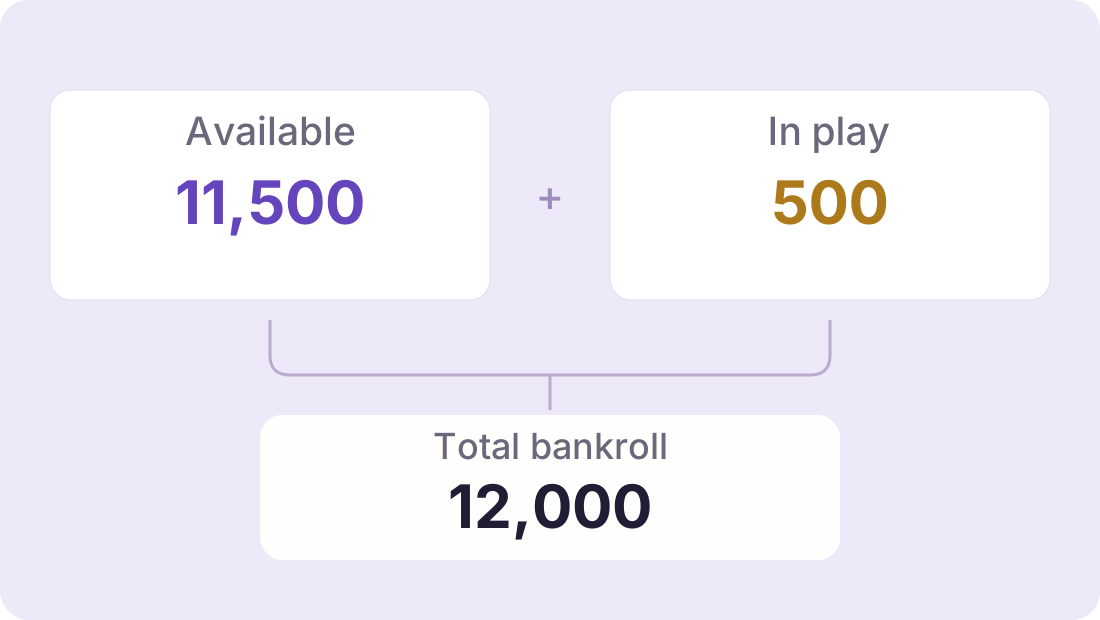
These three numbers answer different questions. Total is the combined balance you are tracking. Available is money outside active sessions. In play is money allocated to sessions still running.
In the illustration below, 12,000 units are split into 11,500 available and 500 in play. The 500 is not yet a completed loss. Until a session ends, a contribution-based tracker should not be mistaken for a live valuation of every chip at the table.
Choose stakes using a reserve, not a feeling
Express a cash-game reserve in the buy-in size you actually use. For example, a 6,000-unit bankroll contains 20 buy-ins of 300 or 30 buy-ins of 200. Those are arithmetic comparisons, not recommendations that either reserve is sufficient.
There is no universally safe number of buy-ins. Game format, stack depth, results variability, your uncertain edge and whether the money can be replenished all matter. A reserve cannot turn a losing game into a profitable one. Decide when you would lower stakes or pause before sitting down.
Budget tournaments by total event cost
A listed entry price can understate what you spend if you re-enter or purchase an add-on. An event with two entries costing 110 each and an add-on of 30 costs 250 in total. If the payout is 400, the event result is +150. If there is no payout, the result is −250.
Include fees once: an entry already quoted as 100 + 10 costs 110, not 120. Large fields, payout structure and re-entry plans change the pattern of results. A cash-game reserve rule should not automatically become a tournament rule.
Use a short before, during and after routine
Before: record the game, stakes, starting time and first buy-in. Set a spending boundary and an intended finish time.
During: record every additional buy-in or re-entry while you remember it. A brief note can capture context without writing a hand history.
After: enter the final cash-out or payout, close the session and check the duration. Record losing and break-even sessions too. Missing losses make a neat history misleading.
Keep transactions separate from results
For a finished cash session, result equals cash-out minus all buy-ins. A 300 buy-in plus a 200 top-up followed by a 650 cash-out produces +150.
Adding 500 from your bank account increases your bankroll but creates no poker profit. Withdrawing money is not a playing loss. Moving 200 between your live and online pools leaves their combined total unchanged. Record outside expenses separately if you want to know the overall cost of a trip, and do not subtract costs twice when they are already reflected in the cash-out.
Review the pattern, then protect the record
Review a group of completed sessions rather than judging your ability from one evening. Check whether spending and stakes stayed within your plan. A short winning run does not prove a long-term win rate, and recovering a loss is not a reason to increase stakes.
If you play in several currencies, preserve original amounts and use a consistent conversion method. Back up your records. Bankroll Manager provides a free, account-free way to record sessions and organize bankrolls on your device; your tracking routine still depends on complete entries and keeping a usable backup.
Your next-session checklist
- Keep essential money outside the poker budget.
- Choose a game and spending limit before playing.
- Record every contribution, then the final cash-out.
- Separate deposits and transfers from playing results.
- Review, back up and lower stakes or pause when the plan requires it.
Good records give you a clearer picture. They cannot remove uncertainty or guarantee a profit.